 +614 2193 1745
A pallet that performs well on one production line may not fit another, even when both machines run at a similar frequency. Choosing pallets for high frequency vibration block machines requires more than matching a material label to a machine type. The key is how the pallet’s characteristics work with the equipment, process and operating conditions.
It’s reasonable to focus on vibration and board movement: instability can affect production consistency, while supplier claims can be difficult to compare without the right operating data. This guide explains what information to gather before selecting a pallet and which characteristics to assess against your machine and process.
You’ll learn how to prepare for a supplier discussion, compare pallet specifications without relying on broad claims, and validate fit through a controlled plant trial. RHINO specializes in composite production pallets for concrete products, but suitability for a specific high-frequency application should be confirmed against the machine and process requirements. Start with the operating evidence, then assess the board.
Key Takeaways
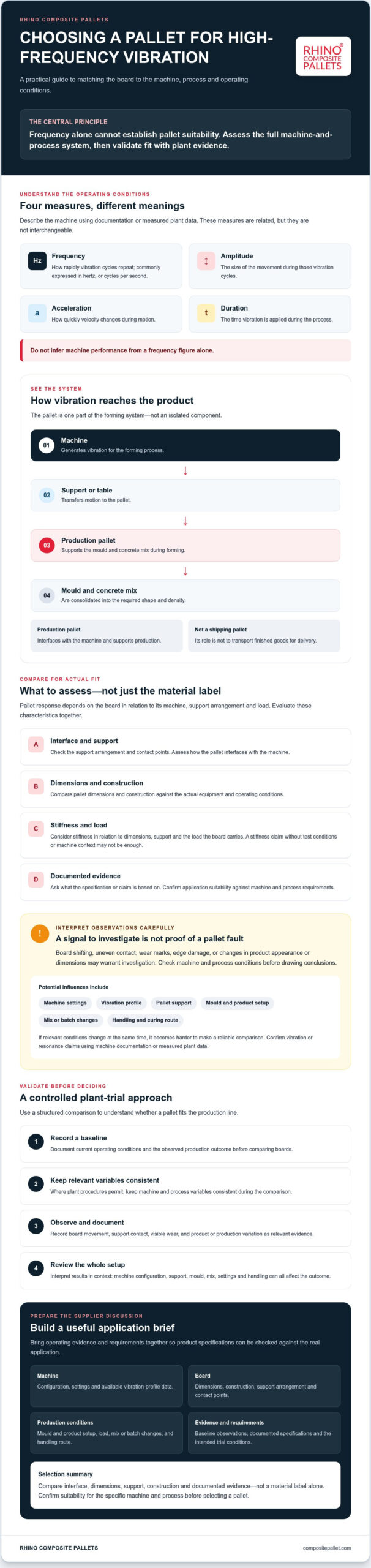
- Separate vibration frequency from amplitude, acceleration and duration to describe your machine’s operating conditions accurately.
- Use observed board movement or production variation as signals to investigate, not proof of a specific pallet fault.
- Compare pallets for high frequency vibration block machines by interface, dimensions, support, construction and documented evidence, not material label alone.
- Validate pallet fit with a controlled trial, recording a baseline and keeping relevant machine and process variables consistent where plant procedures permit.
- Prepare a supplier brief with machine, board and operating requirements. Confirm product specifications and application suitability before considering RHINO composite production pallets.
What high-frequency vibration means for concrete block machine pallets
In a concrete block machine, vibration is part of the forming process. The machine vibrates the mould and concrete mix to consolidate material into the required shape and density. A production pallet supports the forming operation and carries the newly formed units through the production line. It is not a shipping pallet: its role is to interface with the machine and support production, rather than transport finished goods for delivery.
High frequency describes how rapidly vibration cycles repeat. On its own, it does not show how far the machine moves, how intense the motion is, or how long vibration is applied. Those distinctions matter when assessing pallets for high frequency vibration block machines. Frequency, movement, duration and the pallet’s support conditions must be considered together.
How is vibration frequency different from amplitude?
Frequency is the number of repeated vibration cycles over time, commonly expressed in hertz, or cycles per second. Amplitude describes the size of the movement during those cycles. Acceleration describes how quickly velocity changes, while duration is the time vibration is applied. These are related operating measures, but they are not interchangeable. Use machine documentation or measured plant data to establish values. Don’t infer a machine’s performance from a frequency figure alone.
Where does the pallet sit in the vibration system?
The machine generates motion. Its support or table transfers that motion to the pallet, which supports the mould and concrete mix during forming. The response depends on the connected system, including how the pallet is supported and the product and process being run. Resonance can amplify motion when an external force aligns with a system’s natural frequency, as described in this overview of mechanical resonance. That possibility is a reason to assess the full setup, not assume a particular pallet is at fault.
Machine configuration, pallet support, mould arrangement, mix characteristics and process settings all influence what happens during a cycle. A change in finished-product consistency may warrant investigation, but it does not establish the pallet as the root cause. Check operating records and inspect relevant machine and process conditions before drawing conclusions.
For selection, treat the pallet as one element of a production system. A material category or general description cannot establish fit by itself. Check whether the pallet’s dimensions, construction and support interface suit the actual machine and operating conditions. This system-based view provides a sound starting point for comparing boards and planning a plant evaluation.
How high-frequency vibration interacts with a production pallet
Each forming cycle applies dynamic loading through the machine and its support interface to the pallet, mould and concrete mix. Repetition can make small differences in fit, support contact or load distribution worth investigating. But the pallet doesn’t act alone: its response depends on its dimensions and stiffness in relation to the machine, how it is supported, and the load it carries.
Possible observations include a board shifting during operation, uneven contact or wear marks, edge damage, or changes in product appearance or dimensions. Treat these as evidence to examine, not proof of a pallet fault. A vibration or resonance claim also needs evidence. Confirm it against machine documentation or measured plant data rather than assuming a particular frequency is causing damage. The Concrete Masonry & Hardscapes Association technical resources can help teams locate broader concrete masonry production guidance, but machine-specific conclusions require machine and plant evidence.
Which operating conditions change pallet response?
Record the actual production conditions before comparing boards. Include machine settings and available vibration-profile data, pallet dimensions, support arrangement and contact points. Also note the mould and product configuration, production load, mix or batch changes, and the pallet’s route through handling and curing. These factors can affect what the board experiences. If they change at the same time, it becomes harder to make a reliable comparison.
Assess stiffness, dimensions, support and load as a combination. A stiffness claim without the corresponding test conditions or machine context may not predict performance on your line. Keep the same records for each trial board so observed differences can be reviewed alongside operating conditions.
Why should teams avoid blaming the pallet by default?
A visible defect or inconsistent product is a starting point for diagnosis, not a confirmed root cause. Check whether the issue follows one pallet or appears across multiple boards, positions, moulds or production runs. Review board condition and contact marks alongside mould condition, machine operation, mix consistency and process records. A pattern linked to one board may narrow the investigation, but it still needs verification.
Follow plant procedures and OEM guidance when inspecting equipment or changing settings. Don’t alter multiple variables at once. Doing so makes cause and effect harder to establish. A disciplined record of observations and operating conditions gives operators and suppliers a firmer basis for evaluating pallets for high frequency vibration block machines. Plants assessing composite production pallets can also review RHINO composite pallets for concrete production against documented machine and process requirements.
How to evaluate pallets for high-frequency vibration service
Selection should begin with the machine interface and operating evidence, not a material label. A composite pallet may have useful properties, but the word “composite” alone doesn’t establish compatibility with a particular machine, support arrangement or production load. Compare documented characteristics with the conditions on your line.
Which machine and pallet specifications should buyers collect?
Build a reference file before requesting quotes or technical recommendations. Record the machine model, OEM requirements, existing pallet dimensions, support configuration and any available vibration measurements or operating settings from reliable plant sources. Add product types, mould configuration, loading conditions and relevant production observations. This information helps suppliers assess the application rather than rely on assumptions from a general description.
| Comparison area | Information to record or request | What to verify |
|---|---|---|
| Machine interface | Machine model, OEM requirements and pallet contact points | Whether the proposed board fits the specified interface |
| Dimensions | Length, width, thickness and relevant tolerances | How dimensions are measured and whether they match plant requirements |
| Support | Support locations, contact pattern and operating arrangement | Whether the test or recommendation reflects the actual support setup |
| Construction | Material description and documented board properties | Test method, configuration and conditions behind each claim |
| Evidence | Technical records, application references and stated limitations | Whether evidence applies to a comparable machine and process |
What evidence makes supplier comparisons more useful?
Ask suppliers to explain how each claimed property was measured, including the test method, board configuration and operating conditions. A stiffness, dimensional or vibration-related figure without this context may not be comparable with another supplier’s data. Request relevant application references or technical records where available, and distinguish documented results from general claims.
Mark information as unavailable, unverified or non-comparable rather than filling gaps with assumptions. That discipline makes the comparison more useful to engineering, production and purchasing teams. It also clarifies what needs to be checked in a plant trial, instead of treating supplier literature as proof of performance.
Keep pallet selection separate from broad material-versus-material conclusions. Compare materials in a dedicated assessment where available, then return to machine-specific fit. The NCMA design and construction details provide context for concrete masonry construction, but they don’t replace machine-interface specifications or application testing. For pallets for high frequency vibration block machines, the decisive question is whether dimensions, support, construction and evidence match the documented operating conditions.
How to validate pallet fit on a high-frequency vibration production line
A plant trial turns a compatibility claim into evidence from your own line. Define the comparison before the trial begins, then collect the same types of observations for the baseline and candidate pallet. The goal is not to prove a preferred result. It is to determine whether the board fits the machine and process under documented conditions.
How should a plant structure a pallet trial?
Set the objective, comparison conditions, trial duration and responsible team in advance. Use production and safety procedures approved by the plant and machine manufacturer. Where procedures permit, hold machine settings, mould configuration, mix and other relevant variables consistent. Record any unavoidable changes or interruptions, since they can affect interpretation and should not be presented as part of a controlled comparison.
- Establish a baseline. Record the current pallet, operating conditions and plant-selected production indicators.
- Set the trial plan. Identify the candidate board, comparison method, observation points and staff responsible for recording results.
- Observe production. Use the plant’s established methods to capture quality, handling, stoppage and board-condition information.
- Compare and review. Check the records for differences, deviations and possible confounding factors before drawing conclusions.
Which observations should the team document?
Ask plant engineering to select relevant product-quality measures and apply them consistently to both baseline and trial conditions. Record visible board condition, handling observations and unplanned stoppages using existing plant records where possible. Note when each observation occurred and which operating conditions were in effect. Consistent records make the review more useful than informal impressions gathered after a run.
Review the complete set of data before attributing a result to the pallet. A quality change or stoppage may coincide with a trial without being caused by the board. Consider recorded process deviations and other equipment or production factors, then follow plant procedures and OEM guidance for any further checks. Keep conclusions proportional to the evidence.
This method gives teams a practical basis for evaluating pallets for high frequency vibration block machines without relying on material labels or unverified claims. Once machine requirements and trial observations are documented, you can review RHINO’s composite pallet capabilities against your application and confirm relevant specifications with the supplier.
Selecting a production pallet supplier for high-frequency block machines
A useful supplier discussion starts with a complete application brief. For pallets for high frequency vibration block machines, machine identification and operating context matter as much as the board description. Give suppliers enough information to assess fit, then ask them to distinguish documented specifications from assumptions or unverified claims.
What should a technical pallet inquiry include?
Prepare a concise record covering the machine, pallet, production conditions and evaluation objective. Include:
- Machine: model, relevant OEM requirements, approved pallet dimensions and support details.
- Operating data: available vibration measurements, machine settings and the source of each figure.
- Production: product and mould configurations, loading conditions, handling and curing workflow.
- Current concerns: observed board movement, wear, handling issues or production variations, without presenting observations as proven causes.
- Validation goals: the plant’s intended comparison, selected quality measures and trial conditions.
Ask which specifications the manufacturer can provide and what test methods and conditions support them. Request relevant technical records or application references where available. If data is unavailable or not comparable with your setup, ask the supplier to state that clearly. A precise answer is more useful than a broad performance claim.
How can RHINO’s manufacturing capabilities fit the evaluation?
RHINO Composite Pallets designs and manufactures composite production pallets for concrete block machines. Its product lines include Rhino Fabrico, RHINO Synthetico and Rhino Plastico. Their suitability for a particular high-frequency application must be confirmed against the machine requirements and operating evidence. Don’t assume a product line fits based on its name or material category alone.
RHINO identifies precision engineering and refurbishability as areas of focus. Buyers can ask how relevant specifications are established, whether available manufacturing options can align with the plant’s equipment, and what refurbishing processes apply. Treat these as questions for the supplier to confirm, not as guarantees of fit or service life. If certification is relevant to procurement, confirm its current scope and the products or materials it covers.
Use the completed brief to assess the supplier’s technical response and define the next validation step. Discuss your machine and pallet requirements with RHINO.
Make pallet selection a measured production decision
Choosing pallets for high frequency vibration block machines starts with operating evidence, not a material label. Distinguish frequency from amplitude, acceleration and vibration duration, then assess the pallet alongside its dimensions, support arrangement, load and production conditions. Observations such as movement, wear or product variation should guide investigation, not be treated as proof of a pallet fault.
A controlled plant trial gives your team a practical way to compare fit. Set a baseline, define consistent conditions where plant procedures permit, and record agreed quality, handling, stoppage and board-condition indicators. Review deviations before drawing conclusions.
RHINO is a specialist manufacturer of composite production pallets for concrete block machines, with a company-stated focus on precision engineering, durability and refurbishability. Confirm specifications and application suitability against your machine and process requirements. To discuss your documented operating needs, discuss your high-frequency machine and pallet requirements with RHINO. A disciplined evaluation puts your next decision on firmer ground.
Frequently Asked Questions
What makes a pallet suitable for a high-frequency vibration block machine?
A suitable pallet matches the machine interface and performs appropriately under the plant’s documented operating conditions. Compare dimensions, support contact, construction and relevant technical evidence, including the test method and conditions behind supplier claims. For pallets for high frequency vibration block machines, frequency alone isn’t enough to establish fit. Consider the complete setup, including mould, product configuration and load, then confirm suitability through a controlled evaluation on the production line.
Does higher vibration frequency always require a stronger pallet?
No. Frequency by itself doesn’t determine the pallet’s required strength or prove that a stronger board is needed. Pallet response also depends on movement amplitude, acceleration, vibration duration, support arrangement, board dimensions and production load. Start with machine documentation and reliable plant measurements. Then compare relevant pallet properties under stated test conditions. A general claim about strength or vibration resistance isn’t conclusive unless it applies to a comparable machine and operating setup.
Can a composite pallet work in a high-frequency vibration block machine?
Yes, a composite pallet may be suitable, but the material category alone doesn’t confirm compatibility. Check the proposed board’s dimensions, construction and interface against machine requirements, and ask for evidence relevant to your operating conditions. RHINO Composite Pallets manufactures composite production pallets for concrete block machines, including Rhino Fabrico, RHINO Synthetico and Rhino Plastico. Confirm the current specifications and suitability of any product line for your particular high-frequency application.
How do you test a pallet on a block machine?
Use a controlled plant trial planned with the responsible production and engineering teams. Establish a baseline, define the comparison conditions and choose the quality, handling, stoppage and board-condition indicators your plant will record. Keep machine settings and other relevant variables consistent where plant procedures permit. Follow plant safety procedures and machine-manufacturer guidance. Record deviations, then review the complete data before attributing an observed difference to the pallet.
What machine information should I send a pallet manufacturer?
Provide the machine model, OEM requirements, approved pallet dimensions and support arrangement. Include available vibration measurements and operating settings, noting their source, as well as product and mould configurations, loading conditions and relevant production observations. Describe the board issue or selection objective without presenting an unverified cause as fact. Ask the manufacturer which specifications, test methods and supporting records it can provide to assess fit for your application.
Can a new pallet solve inconsistent block production?
It might help if the pallet is shown to be contributing to the problem, but replacement alone can’t establish or guarantee a solution. Inconsistent production may involve other machine, mould, mix or process conditions. Check when the variation occurs, whether it follows a particular board, and what operating changes coincide with it. Review plant records and follow OEM guidance before deciding whether a pallet trial or other investigation is warranted.
What is the difference between vibration frequency and amplitude?
Frequency is how many vibration cycles repeat over time; it’s commonly expressed in hertz. Amplitude is the size of the movement during those cycles. They describe different aspects of vibration and shouldn’t be used interchangeably. Acceleration and vibration duration are also separate operating measures. Use machine documentation or measured plant data to understand the conditions, rather than relying on a frequency figure alone to judge pallet suitability.