 +614 2193 1745
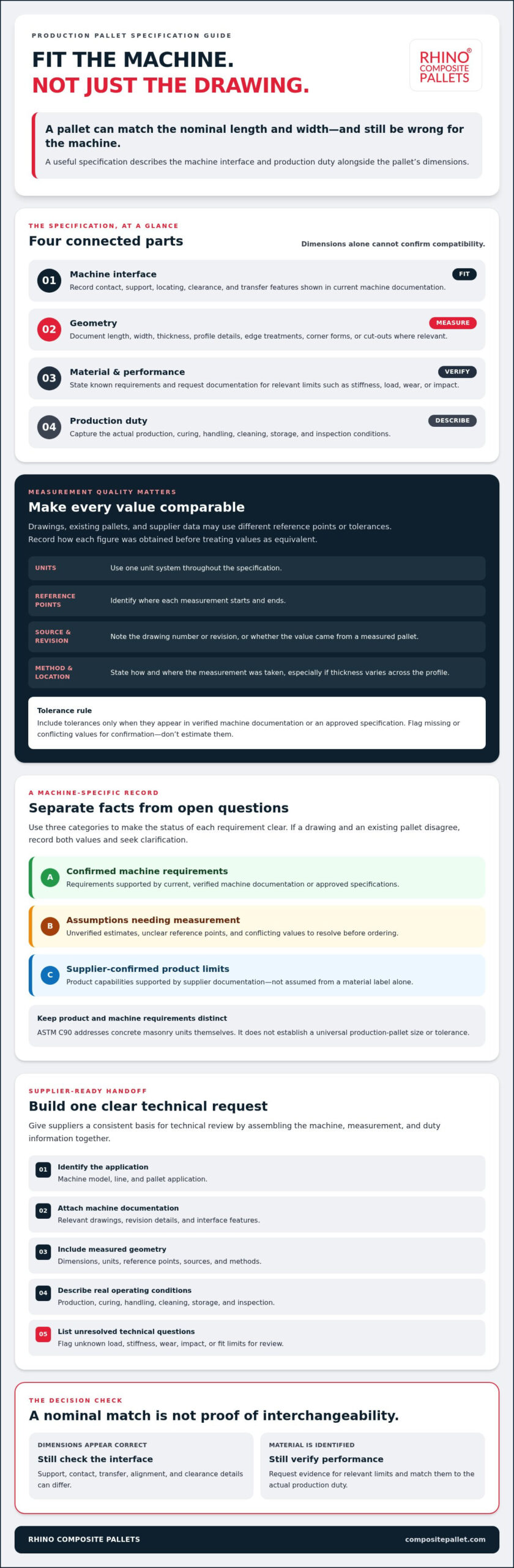
A pallet can be dimensionally correct on paper and still be wrong for the machine. Pallets for Concrete block manufacturing specifications need to account for the machine interface and production duty, not just the pallet’s length, width, and thickness.
This matters when machine drawings and supplier data use different reference points or tolerances. A nominal match may not show how the pallet is supported, transferred, loaded, or exposed to operating conditions. If those details are missing, a replacement may be unsuitable even when its basic dimensions appear correct.
This guide explains what to document before specifying production pallets. You’ll learn which dimensions and tolerances to verify, which machine interfaces to record, and how to describe material properties and operating conditions. It also covers how to assemble those details into a machine-specific specification that gives suppliers a clear basis for technical review.
Key Takeaways
- Treat the production pallet as a machine component. Dimensions alone cannot confirm fit or operating suitability.
- Record measurement units, reference points, and methods so drawings and supplier data can be compared consistently.
- Define verifiable performance needs in your concrete block pallet specifications, and flag unknown load, stiffness, wear, or impact limits for review.
- Document actual production, curing, handling, cleaning, storage, and inspection conditions that shape pallet duty.
- Prepare a supplier-ready request with the machine model, drawings, measurements, operating conditions, and unresolved technical questions.
What Concrete Block Pallet Specifications Need to Define
A production pallet is a machine component, not simply a flat support surface. It interfaces with equipment, carries products through production, and operates under the conditions of a specific plant. Document its fit and duty requirements alongside its physical dimensions.
A complete pallet specification covers interface, geometry, material, and duty-cycle data. Dimensions alone cannot establish compatibility or suitability. A pallet may match a nominal length and width but differ at a machine contact point, edge, or support area. The product matters too: a Concrete masonry unit (CMU) can refer to different unit types, so identify the product and production requirements clearly.
What information belongs in a pallet specification?
Organize the record into core data groups. Identify the machine and pallet application, document the machine interface and geometry, state known material requirements, and describe operating conditions. For each value, note its source, such as a machine drawing, a measured pallet, or supplier documentation.
- Identification: machine model, line, and pallet application.
- Interface: contact, support, and transfer features shown in relevant machine documentation.
- Geometry: dimensions and edge details, with units and measurement references.
- Material and duty: required criteria and operating conditions the pallet must withstand.
Flag missing, inconsistent, or assumed information. Don’t turn an unverified estimate into an acceptance requirement. Resolve open points before ordering.
Why specifications must be machine-specific
Machine design determines how a pallet is located, supported, and moved. Production conditions determine the demands placed on it. Because those requirements can vary between installations, a general product description cannot confirm fit for a particular setup.
Separate the record into three categories: confirmed machine requirements, assumptions needing measurement, and supplier-confirmed product limits. If a drawing and an existing pallet disagree, record both values and ask for clarification. Request documentation for relevant limits, such as stiffness, load, wear, or impact, rather than assuming a material label establishes performance. Verify tolerances for the specific machine instead of relying on universal figures.
Document Dimensions, Thickness, and Machine Interface Requirements
Build the dimensional record from current machine documentation, not a catalogue description or an unverified pallet sample. Capture overall length, width, and thickness, plus any profile details on the drawing, such as corner forms, edge treatments, or cut-outs. State whether each figure is nominal, taken from a drawing, or measured from an existing pallet.
Which pallet dimensions should buyers record?
Use one unit system throughout the specification. For every measurement, identify the reference points and where it was taken. If thickness varies across the profile, specify the location of each measurement. Record the measurement method and the drawing number or revision used for comparison.
If block dimensions inform the pallet layout, identify the product type and relevant product documentation. For loadbearing concrete masonry units, the ASTM C90 Standard Specification addresses the units themselves. It does not establish a universal production-pallet size or tolerance. Keep product requirements separate from machine-interface requirements.
- Record length, width, thickness, and relevant profile or corner details.
- Document the source, units, reference points, and measurement method for each value.
- Include tolerances only when they appear in verified machine documentation or an approved specification.
- Flag unavailable or conflicting values for measurement or technical confirmation. Don’t estimate them.
How to verify machine interface and fit
Check current equipment drawings for locating features, clearances, support points, and transfer interfaces. Confirm the machine model and drawing revision before comparing those details with supplier data. A superseded drawing or a measurement from a different machine setup can lead to a false match.
Compare each interface feature using the same reference points, and record discrepancies. If supplier data uses different units or measurement locations, ask for clarification before treating the values as equivalent. Note any observed contact, alignment, or clearance concern for engineering review. Similar overall dimensions do not establish interchangeability.
Final dimensional limits must come from verified machine documentation or supplier review. Keep unresolved values visible in the specification instead of filling gaps with assumed tolerances. This gives a technical reviewer a clear basis for assessing fit in the specific setup.
For a focused review, share the machine model, current drawings, and recorded measurements with a specialist in production pallets.
Specify Material and Mechanical Requirements Without Guesswork
A material name is not a performance specification. Products within the same broad material category can have different construction and operating limits. In concrete block pallet specifications, define the performance the machine requires, then ask the supplier for product-specific supporting documentation.
Start with engineering’s load cases and support conditions. Identify how the pallet is supported and loaded at relevant machine stages, and whether the review needs to account for deflection. Record production exposures such as vibration, impact, abrasion, and handling where they apply. Product dimensions and shapes can help describe the application; the NCMA concrete masonry unit specifications provide background on CMU forms. They don’t establish pallet performance limits.
Which mechanical properties should the specification address?
Ask the machine or plant engineering team to define applicable load cases, support conditions, and acceptable deflection criteria. Then request supplier evidence for relevant stiffness, load, wear, and impact limits. If a value isn’t available, or its test conditions don’t match the application, mark it for technical confirmation. Don’t substitute generic thresholds or figures from unrelated products.
A comparison record can keep assumptions visible:
| Requirement | Evidence source | Supplier response | Unresolved question |
|---|---|---|---|
| Load and support conditions | Machine documentation or engineering review | Documented limit and test basis | Does the evidence reflect this setup? |
| Stiffness or deflection | Approved requirement or design review | Available product data | What criteria still need confirmation? |
| Wear, impact, vibration | Observed production conditions | Relevant supplier documentation | Are the exposure conditions comparable? |
How to compare composite pallet material options
Compare suppliers against the same verified requirements and operating conditions, not just material labels or broad promotional claims. Ask which option, if any, fits the documented application. RHINO Fabrico, RHINO Synthetico, and RHINO Plastico are product lines, but don’t assume they are equivalent or suitable without product-specific review.
For any claimed durability, refurbishability, or certification, ask for evidence that identifies the scope and applicable product. Treat unsupported limits as open questions, not accepted specifications. Keep comparisons focused on the requirements and evidence needed for a sound technical decision.
Include Curing, Handling, and Inspection Conditions
A specification should reflect the plant where the pallet will operate. Production and curing environments can differ between facilities, so check the conditions behind a supplier’s recommendations before applying them to your operation. Clear operating records make performance discussions more specific and testable.
What curing and production conditions should be recorded?
Describe the curing method and relevant exposure conditions, then note the production cycle and any process changes that could affect pallet service conditions. Use plant records or measurements where available. Label estimates and unverified values clearly so they aren’t mistaken for confirmed operating data.
Include practical details that help a supplier assess the application:
- Production: the operating sequence and relevant changes in process or product.
- Curing: the method and documented exposure conditions.
- Handling: how pallets are moved, transferred, and handled between process stages.
- Cleaning and storage: established practices and storage conditions that may affect the pallet.
Ask the supplier which recorded conditions affect its product limits or recommendations. If a relevant detail is unknown, list it as an open question in the concrete block pallet specifications. This keeps assumptions separate from verified requirements.
How inspection data improves the specification
Inspection history can help engineering teams and suppliers understand observed conditions. Use consistent terms to record wear, deformation, visible damage, and replacement observations. Where plant procedures exist, include inspection frequency, measurement method, and the location of each observation.
Keep the record factual. Note what was observed, when it was recorded, and the pallet or production context. A damaged pallet is evidence of a condition to investigate, not proof of a single cause. Changes in handling, process conditions, or inspection methods may also matter, so keep relevant context with each observation.
This section explains what to record, not how to maintain a pallet or diagnose a failure. Keep detailed guidance on warping, wear, and maintenance in dedicated supporting articles. For a machine-specific discussion of composite production pallets, share your operating and inspection requirements with RHINO Composite Pallets.
Turn Concrete Block Pallet Specifications into a Supplier-Ready Request
A useful inquiry gives the supplier enough verified information to assess the application, identify gaps, and respond with relevant product documentation. Concrete block pallet specifications work best when they distinguish confirmed requirements from estimates and open questions.
What to send with a pallet inquiry
Prepare a concise technical package with current machine identification and drawing revisions, pallet drawings, verified measurements, and relevant setup details. Add documented production and curing conditions, handling practices, and observed issues that may affect service requirements.
- Machine: manufacturer, model, and relevant configuration details.
- Drawings and dimensions: current machine and pallet drawings, measurement units, reference points, and verified measurements.
- Operating conditions: production and curing environment, handling, cleaning, storage, and inspection practices.
- Requirements: known interface and performance criteria, anticipated order requirements, and unresolved questions.
Identify the source of each requirement where possible. Mark estimates as unverified, and note conflicting drawing or measurement information rather than choosing a value without confirmation. Ask the supplier to identify missing inputs, clarify assumptions, and provide applicable product documentation, including relevant limits and the basis for those limits.
How RHINO can support a specification review
RHINO Composite Pallets designs and manufactures composite production pallets for concrete block machines. It manufactures pallets, not block-making machines or finished concrete blocks. A machine-specific technical discussion should focus on the pallet interface, verified operating requirements, and available product evidence.
RHINO Fabrico, RHINO Synthetico, and RHINO Plastico are product lines. Don’t assume a line suits a particular machine or duty cycle based on its name. Share the technical package and ask which option, if any, aligns with the documented requirements. Confirm product-specific dimensions, tolerances, compatibility, and performance limits during review.
Use the information on RHINO Composite Pallets to start a machine-specific discussion. A complete request gives the supplier a clear starting point and helps keep unverified assumptions separate from confirmed engineering requirements.
Put Your Pallet Specification to Work
A sound pallet decision starts with verified machine requirements, not a dimension copied from an old order. Complete concrete block pallet specifications connect interface geometry with material criteria and actual duty conditions. Keep drawing references, measurement methods, and unresolved values visible so engineering teams and suppliers can review the same information.
Before requesting a technical review, confirm the machine model and drawing revision, record relevant operating and inspection conditions, and distinguish plant requirements from supplier-confirmed product limits. Request available evidence for stiffness, load, wear, or impact performance. This turns measurements into a usable technical request and keeps assumptions from being mistaken for approved tolerances.
RHINO Composite Pallets specializes in composite production pallets for concrete block machines. Its product lines include RHINO Fabrico, RHINO Synthetico, and RHINO Plastico. Review suitability and product limits against your specific setup.
Clear documentation gives a machine-specific review a sound starting point. Submit your machine and pallet requirements to RHINO to discuss your application.
Frequently Asked Questions
What dimensions should a concrete block machine pallet have?
Use dimensions verified for your specific machine and production setup. Record overall length, width, thickness, and any edge or profile details shown in current machine documentation. Note the drawing revision, measurement units, reference points, and how each value was measured. Nominal length and width alone don’t establish fit. Confirm unclear or conflicting values against machine documentation or with the supplier before ordering.
How do I find the correct pallet thickness for my block machine?
Confirm thickness from current machine drawings, an approved specification, or a technical review with the supplier. If you measure an existing pallet, record where the measurement was taken and whether thickness varies across its profile. Don’t assume a replacement should copy a worn or deformed pallet without checking the original requirement. Flag missing or disputed values for confirmation instead of estimating a tolerance.
Can composite pallets fit different concrete block machine brands?
They may be suitable for different machines, but compatibility must be verified for the specific model and setup. Brands can differ in pallet support, locating features, transfer interfaces, and clearances. Provide the machine identification and current drawings so the manufacturer can review the interface. RHINO Composite Pallets manufactures composite production pallets for concrete block machines. Confirm the applicable product data and machine requirements rather than assuming a product line will fit.
What material properties should a production pallet specification include?
Specify performance requirements, not just a material label. Ask engineering to identify applicable load cases, support conditions, and deflection criteria, then document relevant stiffness, load, wear, and impact limits. Include vibration, abrasion, or handling exposure where these apply to your process. Request product-specific evidence and its test basis from the supplier. If a limit or supporting document isn’t available, flag it for technical verification instead of inserting a generic value.
How do curing conditions affect concrete block pallet specifications?
Curing and production conditions help define the pallet’s actual operating duty. Record the curing method, relevant exposure conditions, production cycle, and process changes using plant documentation or measurements where available. Identify estimates as unverified. Ask the supplier whether those conditions affect product limits or recommendations. Including this context in concrete block pallet specifications supports a more relevant technical review than assuming every plant operates under identical conditions.
What information should I send a pallet manufacturer for a quote?
Send the machine manufacturer and model, current drawing revisions, pallet drawings, verified dimensions, and relevant setup details. Include operating and curing conditions, handling practices, observed issues, and anticipated order requirements. State the units and measurement references, and separate confirmed requirements from assumptions. Ask the supplier to identify missing information and provide applicable product documentation. This gives the manufacturer a defined basis for reviewing the application and preparing a relevant response.
How can I verify that a pallet meets my machine requirements?
Compare supplier documentation with current machine drawings and approved requirements. Check dimensions, tolerances, interface features, material performance limits, and stated conditions of use. Confirm the machine model and drawing revision, and ask the supplier to resolve discrepancies or unsupported values. Keep open questions visible until they’re answered. A product description or similar nominal dimensions aren’t proof of compatibility, so request a machine-specific technical review before accepting the specification.