 +614 2193 1745
Will composite pallets for concrete block machines work with your press, transfer system, and production routine, or create a new point of friction? A material choice that looks suitable on paper can still cause problems if pallet dimensions, handling requirements, or operating conditions don’t match your line.
That uncertainty is justified. Pallets operate within an established production system, so choosing one takes more than comparing material names. Machine specifications, production demands, and service expectations all matter. Assess any change against the way your plant actually runs.
This guide explains how to evaluate composite production pallets against your machine and process before requesting specifications. You’ll learn what equipment details and operating conditions to gather, how to compare material options against your requirements, and what to clarify about service life and refurbishment. RHINO Composite Pallets specializes in production pallets for concrete block machines. A clear account of your equipment and production needs gives a manufacturer a sound basis for discussing suitable options.
Key Takeaways
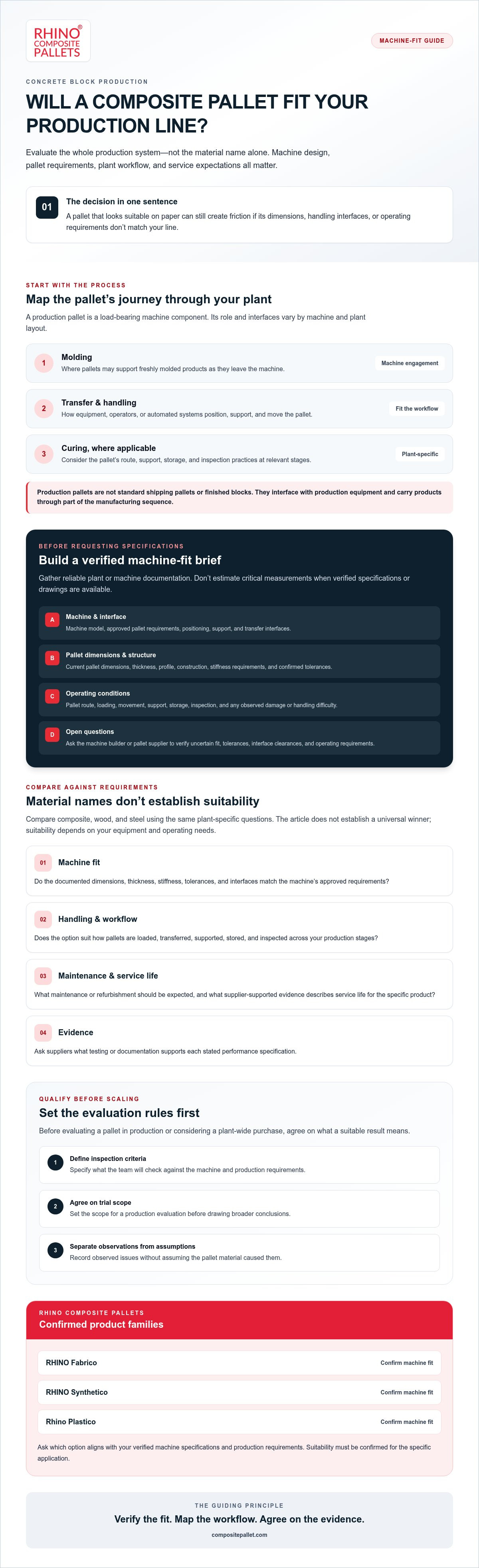
- Assess composite pallets for concrete block machines as part of the full production system, including equipment design and plant workflow.
- Gather verified machine requirements for pallet dimensions, thickness, stiffness, and tolerances before requesting specifications.
- Compare composite, wood, and steel against your handling needs, maintenance approach, and supplier-supported service-life evidence.
- Set inspection criteria and trial scope before evaluating a pallet in production or considering a plant-wide purchase.
- RHINO Fabrico, RHINO Synthetico, and Rhino Plastico are confirmed offerings. Ask which option aligns with your machine and production requirements.
Why Composite Pallets for Concrete Block Machines Must Match the Production System
A concrete block machine production pallet is a load-bearing machine component that supports products as they move through defined stages of block production. Its size, profile, and structural requirements depend on how the machine and plant handle it. The word “composite” describes a broad class of composite materials, not a guaranteed fit or performance level for a particular production line.
Production pallets are not standard shipping pallets, and they are not finished concrete blocks or pavers. They interface with production equipment and carry products through part of the manufacturing sequence. A pallet with the wrong dimensions or handling interface can disrupt established operations, even if its material seems suitable.
Assess composite pallets for concrete block machines against machine design and plant workflow, not by material name alone. Before treating an option as suitable, compare its specifications with the requirements for your equipment and the stages where the pallet will be used.
What role does a production pallet perform in block making?
A pallet’s position in the process varies by plant. Depending on equipment and layout, it may support freshly molded products as they leave the machine, pass through transfer or handling equipment, or proceed to curing. The required interfaces and handling practices differ across those stages. Map where pallets enter and leave the process, how equipment engages them, and how operators or automated systems transfer them. These details define working requirements more accurately than a general material description.
Which plant conditions shape the pallet decision?
Record the existing setup before requesting specifications. Start with the machine model and available pallet requirements, then document the current pallet’s details. Include dimensions, thickness, profile, and any known tolerances from reliable plant or machine documentation. Don’t estimate critical measurements when verified specifications or drawings are available.
Map the pallet’s route through relevant stages, including molding, handling, and curing where applicable. Note how pallets are loaded, moved, supported, stored, and inspected. Separate observed operating facts from assumptions. For example, your team may know the pallet’s measured dimensions but still need the machine builder or supplier to confirm required tolerances or interface clearances.
- Record: machine model, pallet dimensions, and confirmed equipment requirements.
- Map: pallet movement and handling at each applicable production stage.
- Verify: uncertain fit, tolerance, and operating requirements with the machine builder or pallet supplier.
This preparation gives you a sound basis for comparing options. RHINO specializes in composite production pallets for concrete block machines, but suitability for a specific machine or application must be confirmed against its requirements.
How to Evaluate Composite Pallet Engineering for Your Block Machine
Evaluate a pallet against four requirements: machine fit, structural demands, operating environment, and maintainability. A specification is useful when it explains how the pallet fits with the way your equipment engages, supports, and moves it. A material name or broad durability claim can’t establish whether a design suits your machine.
Pallet performance depends on matching verified design requirements to actual operating conditions. Dimensions and tolerances establish fit; stiffness and construction relate to the demands placed on the pallet in operation. Maintenance and refurbishment information help clarify what to expect over its service life, but should be confirmed for the specific product.
Which specifications should buyers verify first?
Request approved pallet dimensions, tolerances, and interface details from the machine builder. Check how the pallet is positioned, supported, and transferred. Confirm requirements for stiffness and thickness rather than estimating them from an existing pallet alone. Record the current pallet construction and any observed issues, such as damage or handling difficulty, without assuming the material caused them. Ask suppliers what testing or documentation supports each stated performance specification.
Use this checklist to organize the information:
- Machine fit: approved dimensions, tolerances, contact points, and interface details.
- Structural demands: verified requirements for stiffness, thickness, and support.
- Maintainability: product-specific inspection, repair, or refurbishment guidance.
How do operating conditions affect material requirements?
Document what the pallet actually encounters: vibration, repeated handling, moisture, abrasion, and curing conditions where applicable. Where your plant can verify them, note the location, frequency, and nature of each exposure. Concrete technology guidance from the American Concrete Institute can inform understanding of concrete processes, but it doesn’t replace machine-specific pallet requirements or evidence for a particular product.
Give suppliers this operating record and ask how the proposed composite construction addresses each condition. Request product-specific evidence for claims about resistance, durability, or service life. A result observed in one plant or application shouldn’t be treated as proof of performance in another without checking whether the test conditions and application are comparable.
For a focused product discussion, share your machine and pallet requirements with RHINO. Clear inputs help keep the evaluation tied to documented fit and actual operating conditions.
How Composite Pallets Compare With Other Options for Block Production
Compare composite, wood, and steel against the same plant requirements. A material label can’t confirm fit, handling compatibility, or service life. Ask for evidence about the specific pallet construction and intended machine application, then assess it against documented operating conditions.
The table below is a buyer’s framework, not a claim that one material always performs better. Treat unavailable information as a question for the supplier, not a gap to fill with assumptions. Resources from the Concrete Masonry & Hardscapes Association can provide wider industry context, but they don’t replace product-specific qualification.
What should a material comparison table include?
Start with verified machine fit and the way each pallet is handled in your production sequence. Then compare the maintenance information and refurbishment options each supplier can document. Apply the same questions to every candidate, including your current pallet. That keeps the evaluation focused on operational requirements rather than assumptions about a material category.
| Buyer criterion | Composite | Wood | Steel |
|---|---|---|---|
| Verified machine fit | Confirm dimensions, tolerances, and interfaces for the proposed pallet. | Confirm dimensions, tolerances, and interfaces for the proposed pallet. | Confirm dimensions, tolerances, and interfaces for the proposed pallet. |
| Handling requirements | Verify compatibility with plant handling equipment and practices. | Verify compatibility with plant handling equipment and practices. | Verify compatibility with plant handling equipment and practices. |
| Maintenance approach | Request product-specific inspection and maintenance guidance. | Request product-specific inspection and maintenance guidance. | Request product-specific inspection and maintenance guidance. |
| Refurbishment and service-life evidence | Ask whether refurbishment applies and what evidence supports expected service life. | Ask whether refurbishment applies and what evidence supports expected service life. | Ask whether refurbishment applies and what evidence supports expected service life. |
For each answer, record its source: machine documentation, supplier specification, or operating history. If a supplier can’t provide evidence for a criterion, mark it as unconfirmed and resolve the question before treating the option as qualified.
When is a composite option worth evaluating?
Consider a composite option when your plant wants to assess durability or refurbishability against defined operating needs. RHINO identifies durability and refurbishability as product strengths. Check those claims against the proposed product’s specifications and applicable refurbishment information. Suitability still depends on the machine and production application.
For composite pallets for concrete block machines, request evidence tied to the exact construction and intended use. Compare it with the same records for wood and steel, then assess each option against confirmed fit, handling, maintenance, and service-life information. No material category replaces verification.
How to Qualify a Composite Pallet Before a Plant-Wide Purchase
A plant-wide change should follow a documented evaluation, not a favorable first impression. Before production testing begins, align plant stakeholders and the supplier on trial scope, inspection criteria, and the records needed to judge the result. This gives operations, maintenance, and procurement a shared basis for deciding whether to proceed.
Use this sequence to move from initial information gathering to a clear purchasing decision:
- Step 1: Assemble machine information. Record the machine make and model, verified pallet dimensions, and relevant interface requirements. Use approved drawings or machine documentation where available, and flag details that still need confirmation.
- Step 2: Describe the production setting. Summarize the workflow and operating conditions the pallet will encounter. Include relevant handling stages, exposure conditions, and current pallet-related concerns. Describe what operators observe without assuming the cause.
- Step 3: Prepare procurement details. Specify the anticipated order quantity and delivery needs for the supplier discussion. Provide enough context to clarify the purchasing requirement without treating preliminary estimates as final specifications.
- Step 4: Agree on trial scope and acceptance criteria. Before testing, define which pallets will be evaluated, where and how they’ll be used, and what the plant will inspect. Criteria might cover verified fit, handling observations, visible condition, or other measures agreed with the supplier. Set the recording method and assign responsibility for each observation.
- Step 5: Evaluate and review the evidence. Record results under comparable operating conditions. Note interruptions, process changes, or unusual events that could affect interpretation. Review deviations with the supplier, then have production, maintenance, and procurement assess the findings together before considering a wider purchase.
A limited evaluation is useful only if the plant can interpret it. An uncontrolled trial with changing conditions or inconsistent inspections can’t establish that a pallet caused an observed result or will perform reliably across the line. Keep records tied to dates, equipment, operating conditions, and inspection criteria. Separate measured facts from operator comments and unresolved questions.
For composite pallets for concrete block machines, give the supplier a clear picture of the machine, order requirements, and intended evaluation. Share those details early, and confirm which specifications and claims apply to the proposed product and application. If a trial produces mixed findings, investigate the differences before scaling rather than relying on a single favorable result.
Discuss your plant’s pallet requirements with RHINO to start a product discussion grounded in your equipment, operating needs, and procurement details.
How RHINO Composite Pallets Supports a Machine-Specific Buying Decision
RHINO Composite Pallets designs and manufactures composite pallets for concrete block machines. A manufacturer discussion is most useful when it addresses equipment and production requirements already documented at the plant. A product name alone doesn’t confirm compatibility. Let machine details, pallet specifications, and operating conditions guide the conversation.
RHINO’s offerings include RHINO Fabrico, RHINO Synthetico, and Rhino Plastico. Ask RHINO to identify an option based on your verified requirements, then request the applicable specifications and supporting evidence before comparing it with alternatives. Confirm product-specific differences rather than assuming that the names alone indicate which line suits a particular machine.
RHINO identifies precision engineering, durability, and refurbishability as product strengths. Treat these as points to examine, not substitutes for product documentation. Request specifications and evidence relevant to the proposed pallet, and ask what refurbishment involves for that product. RHINO also states that it has FSC certification. Verify its current status and which products and claims it covers before relying on it in procurement or sustainability documentation.
What should buyers confirm about RHINO product lines?
Ask which RHINO line aligns with your machine, approved pallet dimensions, interface requirements, and documented operating conditions. Request product-specific details for each option under consideration, including the test basis for any performance claims. If a specification or claim isn’t documented for the proposed product, keep it marked as unconfirmed until clarified.
Confirm whether the stated FSC certification applies to the product being considered and to the specific claim you intend to make. Certification scope matters. Don’t assume that a company-level statement automatically covers every product line or attribute.
What details help start a useful supplier conversation?
Prepare a concise procurement brief that brings machine, production, and order information together. Include:
- Machine data: make and model, approved pallet dimensions, tolerances, and interface requirements.
- Operating context: production workflow, relevant handling and environmental conditions, and current pallet-related concerns.
- Order requirements: intended volume and delivery expectations to discuss with the manufacturer.
- Open questions: product specifications, supporting evidence, refurbishment procedures, and documentation, including certification scope where relevant.
A structured brief helps RHINO assess the application without presuming that one product line fits every block machine. It also gives your team a clear record of what has been verified and what still needs confirmation. Share your requirements, ask focused questions, and evaluate the proposed pallet against actual plant conditions.
Contact RHINO about composite production pallets to discuss your machine specifications, operating context, and product suitability.
Make Your Next Pallet Decision With Clear Requirements
The right pallet choice starts with verified machine fit, not a material label. Confirm dimensions, tolerances, interfaces, and operating conditions, then compare options using consistent criteria for handling, maintenance, and supplier-supported service-life evidence. Before a plant-wide purchase, define the evaluation scope and inspection criteria so the results can support a sound decision.
These steps help determine whether composite pallets for concrete block machines suit your production system. RHINO specializes in composite production pallets for block machines and identifies precision engineering and refurbishability as product strengths. Ask for product-specific specifications and evidence, and verify which products and claims are covered by the stated FSC certification.
Bring your machine details, approved pallet requirements, operating context, and order needs into the supplier conversation. Discuss your machine requirements with RHINO and take the next step with a clear basis for assessing product suitability. A disciplined evaluation helps your plant make a decision grounded in its own requirements.
Frequently Asked Questions
Are composite pallets suitable for every concrete block machine?
No. Suitability depends on the machine’s approved pallet dimensions, interfaces, operating conditions, and production process. The material label alone can’t establish compatibility. Check machine documentation and share the relevant requirements with the pallet manufacturer. Before approving a production trial or purchase, request product-specific specifications and supporting evidence. If key requirements are uncertain, confirm them with the machine builder rather than relying on assumptions or measurements from an unverified pallet.
How do I choose composite pallets for a concrete block machine?
Start with the machine make and model, approved pallet dimensions, and interface requirements. Then document production conditions, handling practices, and any current pallet concerns. Ask suppliers how the proposed product addresses those requirements and what evidence supports its specifications. Compare composite pallet options against the same criteria. Agree on trial scope and acceptance criteria before considering a wider rollout.
What information does a supplier need to specify a production pallet?
Provide the machine make and model, confirmed pallet dimensions and tolerances, relevant interface details, and production context. Describe handling and environmental conditions, including curing conditions where applicable. Include your intended order volume and delivery requirements to frame the manufacturing discussion. If a measurement or specification isn’t confirmed, identify it as an open question. The supplier can then clarify what information is needed rather than base a recommendation on an assumption.
Can composite pallets be refurbished?
RHINO identifies refurbishability as a product strength, but confirm the options and procedures for the specific pallet under consideration. Ask which products may be eligible, what inspection criteria apply, and what refurbishment involves. The pallet’s construction and condition may affect the answer. Don’t assume every composite pallet can be refurbished or that methods are interchangeable. Request product-specific guidance and supporting details before including refurbishment in service-life or procurement planning.
How can I compare composite pallets with wood or steel?
Compare each option against the same machine requirements and operating conditions. Review verified machine fit, handling requirements, maintenance approach, refurbishment considerations, and supplier-supported service-life evidence. Ask for documentation tied to the exact pallet construction and intended application. Avoid treating broad statements about composite, wood, or steel as proof of performance. Mark missing or supplier-dependent information clearly, then resolve those gaps before deciding which option meets your plant’s requirements.
What should a plant test before ordering composite pallets in volume?
Before an evaluation, agree with the supplier on the scope, operating conditions, inspection method, and acceptance criteria. Record observations consistently and note any process changes or unusual conditions that could affect results. Include production, maintenance, and procurement stakeholders in the review. Compare findings with the agreed criteria, and investigate deviations before scaling. A limited evaluation can inform a purchasing decision, but it doesn’t prove performance in every machine or production environment.
Does RHINO sell concrete block machines as well as pallets?
No. RHINO Composite Pallets focuses on designing and manufacturing composite production pallets for concrete block machines. Buyers must source machine equipment separately and confirm pallet requirements against machine documentation or with the machine builder. RHINO’s product offerings include Rhino Fabrico, RHINO Synthetico, and Rhino Plastico, but suitability depends on the specific machine and application. Prepare your machine details and approved pallet requirements to support a focused product discussion with RHINO.